Why I Left UX for Product Management 5 Years Ago
"A candid look back at the doubts, imposter syndrome, and wins for anyone wondering if PM is the next step."
Credit: Nick Fewings
Change isn't easy, but sometimes it's exactly what you need. Five years ago, I made a big one: I moved from being a UX Lead, where I'd spent years honing product experience design, to a full-time Product Management role. It started with an opportunity from management and turned into an internal promotion. Looking back, it feels like the most natural step I could've taken, even though it came with plenty of doubts and learning curves along the way.
This post is for anyone thinking about a similar shift. I'll share why I did it, what scared me, what I've learned, and how my design background still gives me an edge today. Hopefully, it helps if you're feeling that "now what?" itch in your own career.
Why I Made the Shift
I'd been in design for years, mostly in finance and fintech, building experiences where trust, clarity, and conversion really matter. I loved making complex flows feel intuitive, watching users confidently complete high-stakes actions like transferring money or opening an investment account because of thoughtful design. But over time, I realized design was one part of a much bigger picture. I wanted more influence on the full product: how it grows, how it navigates regulations, how it fits the market, and how it hits business goals.
Product Management felt like the logical next step. Design is about crafting the experience; PM is about owning the whole lifecycle, from spotting user needs and aligning with strategy to prioritizing what gets built and measuring impact. I wanted to connect those dots between design, business, and growth.
The opportunity came up internally. Management saw I was already dipping into product work and trusted me to take on more. I went for it, got promoted, and haven't looked back.
How My UX Background Gives Me an Edge
Coming from UX in fintech, I didn't start from zero. That foundation still shapes how I approach PM work every day:
Deep user empathy: Years of research, testing, and interviews in sensitive domains taught me to put users first, especially when trust is on the line. I know pain points intimately and how small changes can reduce friction or build confidence.
Data-driven mindset: Fintech lives on A/B tests, analytics, and behavioral data. Now I use that rigor to inform roadmaps, experiments, and growth decisions.
Business and regulatory awareness: Dealing with compliance, risk, monetization models, and retention in regulated environments made business trade-offs feel natural from day one.
Collaboration muscle: Designers in fintech work closely with legal, compliance, engineering, and risk teams. I've carried that over to aligning diverse stakeholders without friction.
A lot of PMs come from other paths, but this user-centered, trust-focused lens, honed in fintech, is my superpower.
Credit: Noah Levin
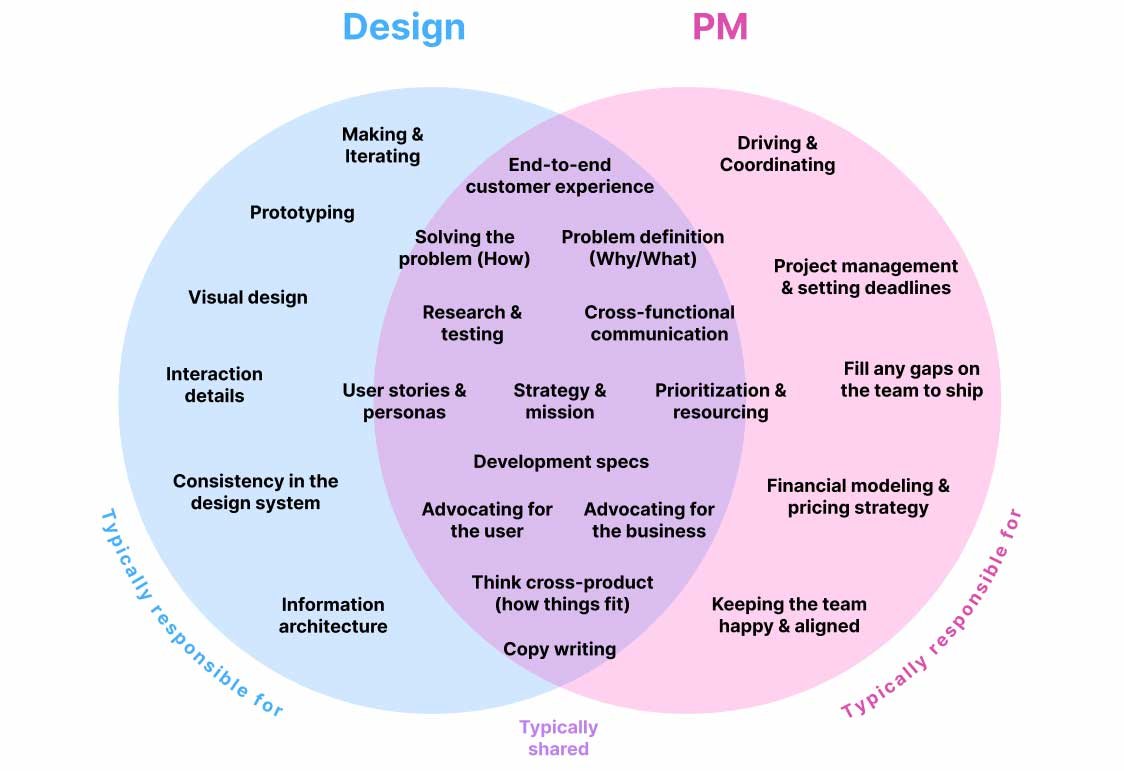
What Product Management Actually Looks Like (vs. Design)
Roles blur across companies, but in healthy teams, PMs and designers are true partners. Both need to understand users, the product, and its impact to make smart calls.
As a PM, I oversee the bigger cycle without directly owning design or dev. My core responsibilities boil down to:
Setting vision and strategy: Figuring out where the product needs to go, based on user needs, business goals, competition, regulations, and constraints.
Prioritizing and breaking down work: Turning big ideas into actionable tasks, building timelines with engineering, and staying available for questions as things move.
Constant user feedback: Talking to customers regularly, interviews, surveys, data to validate, prioritize, and loop insights back to the team.
Keeping everyone aligned: Syncing with stakeholders, communicating progress, and ensuring the whole team understands short- and long-term focus.
Design, meanwhile, translates those requirements into consistent, delightful, and trustworthy experiences, research, ideation, flows, visuals, and guiding implementation.
PM is more about leadership, operations, and strategy. Design is craftsmanship. Both are essential, just with different strengths.
The Decision and the Jump
It came down to curiosity and a desire for more challenge. I'd been on the same path for a while, getting comfortable, maybe too comfortable. As creatives, we crave new problems to solve. I didn't want to manage designers yet, but I did want greater influence over the product itself.
I'd worked with great PMs who inspired entire teams with clear vision and open communication. I wanted to understand their perspective: how they set strategy, scope features, navigate trade-offs, and balance user needs with regulatory realities. What happened before designs landed on my desk?
Luckily, I was already handling some product tasks. Management encouraged me to take on more, so I eased into doing both roles for a bit. Eventually, I knew I needed clear boundaries to really grow. Jumping between exporting assets and running analysis wasn't sustainable.
The internal move wasn't automatic. There were discussions about fit, team dynamics (especially since I'd now work with designers), and even interviews. But staying in the same team meant I kept great colleagues and company context, no total culture shock.

Credit: Max MX
Practical Steps If You're Thinking About the Switch
If you're a designer eyeing PM, here's what I'd recommend based on my experience:
Start small: Volunteer for product-related tasks, user interviews, roadmap input, prioritization discussions, or competitor teardowns.
Document impact: Track how your design work drove metrics (e.g., reduced drop-off in onboarding by X%, increased trust signals leading to higher completion rates).
Talk to your manager early: Express interest openly and ask for stretch assignments.
Shadow PMs: Sit in on their meetings, ask to join discovery calls.
Build a case: When the time comes, show evidence of your strategic thinking and business alignment.
The Early Days (and Imposter Syndrome)
Those first months were rough. Imposter syndrome hit hard.
Suddenly, my "deliverables" weren't screens; I was accountable for timelines, KPIs, and team outcomes. Success meant getting things done through others: engineers building, designers crafting, compliance approving, marketers launching.
I worried about gaps, especially around deeper business strategy. How would I evaluate my own progress when feedback was less tangible?
One early task was a full competitor analysis. It took forever. I had to learn how to research strategy beyond UI patterns: What's their go-to-market? How do they handle regulation? What can we borrow or avoid?
The biggest shift: getting comfortable with ambiguity. Design often has clearer "right" answers you can prototype and test. PM means making decisions with incomplete info, balancing user vs. business vs. regulatory needs, and iterating quickly.
But with time and repetition, it clicked. Mistakes became lessons. Asking questions (even repeatedly) became normal. Growth mindset won out.
What 5 Years as a PM Has Taught Me
Looking back now:
The influence is bigger, but so is the accountability; one missed priority can set things back quarters.
Technical and regulatory gaps close faster than you fear; focus early on sharpening business acumen.
User empathy from UX remains my biggest advantage; it's easy for PMs to drift toward spreadsheets and lose sight of real people.
Ambiguity never fully disappears; you just get better at navigating it with confidence.
Daily Reminders That Keep Me Grounded
Five years later, some habits still help:
Learn from every mistake—analyze why, then adjust.
Ask questions freely; better than guessing.
Take detailed notes, summarize meetings with clear actions.
Stay organized; list tasks, prioritize ruthlessly.
Guard your time; skip non-essential meetings, block focus hours.
Take initiative, own outcomes, support the team.
Seek help and feedback constantly.

Credit: Erwan Hesry
Resources That Helped
A few things made the learning curve less steep:
Inspired by Marty Cagan – How to build products users love (and great PM habits).
👉🏻 Buy at Amazon here 👈🏻
How to Win Friends and Influence People by Dale Carnegie – Timeless on communication and leading without ego.
👉🏻 Buy at Amazon here 👈🏻
Zero to One by Peter Thiel – Thinking about true innovation vs. incremental copies.
👉🏻 Buy at Amazon here 👈🏻
The Subtle Art of Not Giving a F*ck by Mark Manson – Embracing uncertainty and action over perfection.
👉🏻 Buy at Amazon here 👈🏻
Final Thoughts: No Regrets
Five years in, this transition still feels like the best decision I made. It's challenging, exciting, and lets me impact products at a deeper level. My design roots, especially from fintech, keep me grounded in real user needs as I navigate strategy, growth, and regulation.
People often ask if I miss designing. Sure, sometimes, I loved the craft. But design is a mindset for me, not just a tool. Now I "design" experiences conceptually: shaping roadmaps, experiments, and outcomes.
If you're a designer feeling stuck or curious about the bigger picture, go for it. The skills transfer more than you think, and the growth is worth the initial discomfort.
Have you made (or considered) this switch? What scared or excited you most?
Drop it in the comments. I reply to everything.