
Credit: Austin Distel
We know Samsung's vision has long centered on cutting-edge innovation in consumer electronics, emphasizing seamless user experiences and technological leadership.
In 2016, the Galaxy Note 7 smartphone was plagued by battery defects that caused devices to overheat, catch fire, or explode, leading to injuries, property damage, and airline bans on the product. Reports of over 90 incidents in the U.S. alone triggered massive recalls, halted production, and caused billions in losses, eroding consumer trust and potentially dooming Samsung's mobile division amid fierce competition from Apple.
Adhering to its innovation-driven vision, Samsung acted transparently: it recalled 2.5 million units globally, invested in an independent investigation involving 700 engineers, revamped battery-testing protocols, and introduced an 8-point safety check for future devices.
They also communicated openly via press conferences and ads, framing the failure as a learning opportunity to enhance quality. This approach not only contained the damage but boosted brand value by 9% the following year, with the subsequent Galaxy S8 achieving record sales.
Without this vision-fueled pivot toward superior safety standards, the scandal could have permanently tarnished Samsung's smartphone reputation.
The incident left scars, but the swift, expensive, values-first response rebuilt trust faster than statements alone could have. It proved that when a strong mission is deeply embedded, teams know exactly which way to move in chaos, even when it hurts in the short term.
As I worked mostly with SaaS businesses, we've seen this pattern over and over. Companies with a sharp product vision stay motivated, make better decisions, and actually get somewhere. Teams without one spin in circles, arguing over features and losing the "why." In this post, we'll walk through what product vision really is, why it matters, what makes a good one, and how to create yours. We'll throw in some solid examples from big players, too.
What is product vision?
No universal definition.
Sometimes it's a punchy sentence, sometimes a short doc or vision board. At its heart, it answers:
Why does this product exist?
What problem does it solve?
Who is it for?
And what better future does it create?
It's your end goal, how you want users to feel about the product, and where you want to stand in the market. We split them into functional (straightforward answers to who/what/how) and aspirational (big, emotional, inspiring). Mix them if it fits. The key: it's your filter for every decision. Feature? Pivot? If it doesn't move toward the vision, cut it.
Why bother with a product vision?
Founders and product leads feel it first; it gives focus and energy and helps them spot real opportunities rather than shiny distractions. For teams, it's glue. Shared purpose reduces conflict and keeps everyone rowing in the same direction. In agile, it's the North Star for sprints and backlogs. It boosts productivity: shorter prioritization fights, easier alignment, faster MVPs. Marketing bonus: A strong vision sells itself. It tells customers what you're about and builds loyalty.
What makes a good product vision?
Too many gather dust while teams drift. A strong one survives because it:
Nails one main goal (not a list).
Stays short, clear, memorable, zero jargon.
Avoids spec-sheet vibes.
Sparks real excitement and purpose.
Holds up through pivots
If it can guide you through a crisis like Samsungs' 2016 moment, it's gold.
How to create a product vision that rocks?
Don't solo it.
Even founders should bounce ideas off others. For teams, gather stakeholders and key players for focused brainstorming.
Try this: Everyone writes their version. Pass left, edit the one you get. Repeat rounds. Compare and mine common threads. Force contrast: "What will we build?" vs. "What will we never build?" Sharpens fast. Ask tough questions:
First impression of the product?
What do users really need/want?
How big is this problem?
Market position today?
Tech ready?
Ideal customer?
Why us over competitors?
Use an empathy map (a classic design thinking tool). Run quick user surveys first; real data will strengthen the vision and make it more realistic. Tools like Mural/Miro have vision board templates.
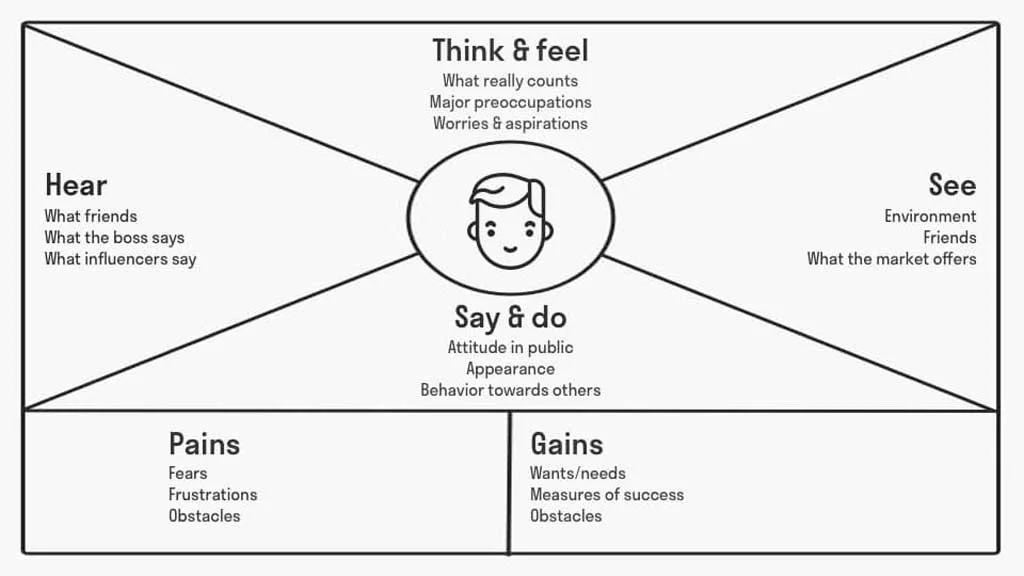
Classic Empathy Map
Some outstanding examples of product visions
Tesla:
Tesla's product vision stands out as one of the most powerful and enduring examples, bold, ambitious, and industry-shaping. The core mission, as stated directly on Tesla's official site, is: "to accelerate the world's transition to sustainable energy." It's short, memorable, and purely aspirational: it rallies the team around a single massive goal while covering EVs, solar, batteries, and more.
Amazon:
Amazon's product vision is one of the most influential and consistent in business, laser-focused on the customer above all else. The core statement, as confirmed on Amazon's official "About Us" page, is: "to be Earth's most customer-centric company." It often expands to include "Earth's best employer" and "Earth's safest place to work," but customer obsession remains the North Star that drives everything.
Google (Search):
Google's (Search) product vision is timeless and elegantly simple, one of the most enduring in tech. The core mission, unchanged as of January 2025, is: "to organize the world's information and make it universally accessible and useful." A popular shorthand vision expands it to: "To provide access to the world's information in one click." It captures the promise of speed, simplicity, and instant value.
Apple:
Apple's product vision is aspirational and uncompromising, classic Steve Jobs energy blended with modern responsibility. The most widely cited and enduring vision statement is: "to make the best products on earth, and to leave the world better than we found it."
It's bold, dual-focused: relentless excellence + meaningful positive impact.
As of today, Samsungs’ vision statement is: "to inspire the world with our innovative technologies, products and design that enrich people’s lives and contribute to social prosperity by creating a new future."
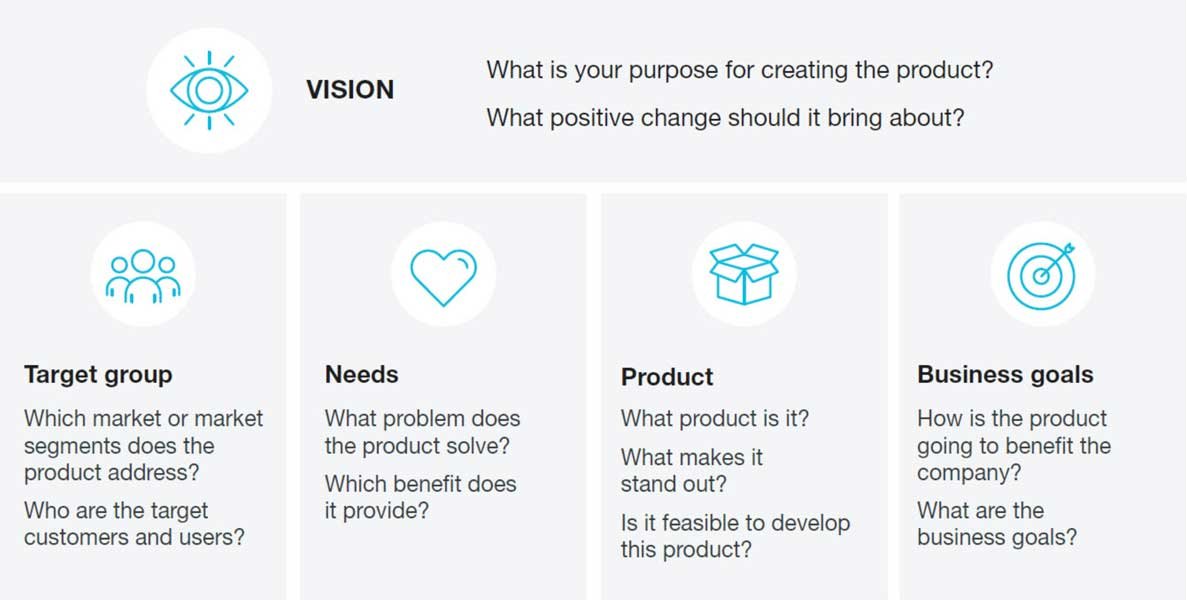
Product Vision Board
A simple product vision template, start here (fill-in-the-blank):
For [target users]
who [need/want to achieve something],
Our [product name] is a [category]
that [key benefit].
Unlike [competitor],
We [unique edge].
Or shorter/aspirational:
To [big impact],
by [how],
for [who].
Tweak and keep it tight.
Conclusion
A solid product vision is one of the strongest tools in your product arsenal. Whether a crisp statement, document, or video, it spells out who it's for, what problem it solves, and the value it brings. Keep it front and center, on walls, in kickoffs, during messy times. It'll remind everyone why you started. We hope this guide gets you rolling on yours.
Now go write it. The clearer the vision, the easier everything else gets.