A quiet revolution is reshaping digital design and most designers haven't noticed it yet.
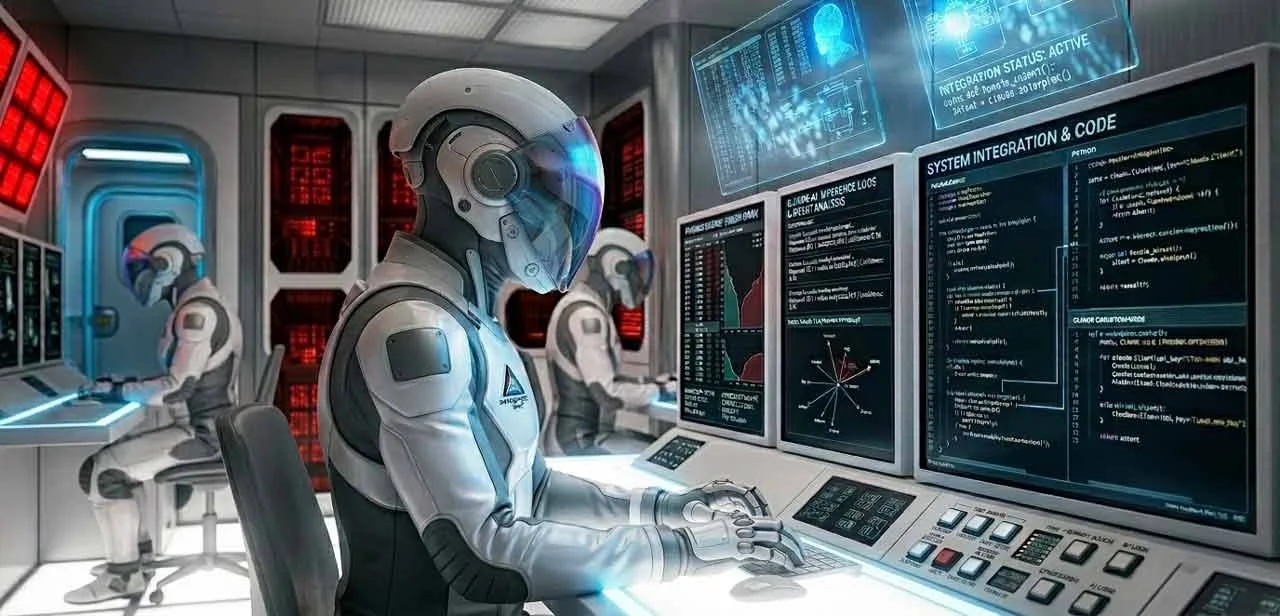
For thirty years, we've built the internet for human eyes. We've agonized over the right shade of blue for a button, the exact weight of a headline, the friction of a checkout flow. Every decision orbited the same centre of gravity: the person on the other side of the screen.
That centre is shifting. A new kind of user is entering the room. one without eyes, fingers, or patience for pretty animations. It's called an AI Agent, and it's already browsing your product.
What is MX Design?
Before we get into the "how," let's make the "what" concrete.
Right now, if you want to book a flight, you open a browser, scan a dozen tabs, compare prices, and click "Buy." Standard UX, you're the user. Now fast-forward two years. You tell your personal AI: "Book me a flight to Tokyo, next Tuesday, under $800, extra legroom." Your AI handles the rest. It visits travel sites on your behalf. It doesn't admire the hero image or the loading animation. It scans for structured data: price, availability, seat type. Then it books the flight and reports back to you.
That invisible interaction between your AI and the product is the Machine Experience (MX). And designing for it is MX Design.
Why is this happening now?
We are becoming increasingly time-poor, and AI is becoming increasingly capable. The result is a growing class of "digital chores", buying groceries, scheduling appointments and comparing insurance plans that people are handing off to AI agents.
This is pushing us toward what's called the Headless Internet: a web that is navigated not by human clicks but by machine logic. When your site talks to a human, it uses colour, shape and emotion. When it interacts with an AI, it uses structure, labels, and a data hierarchy.
If your "Buy Now" button isn't correctly labelled in the underlying code, the AI agent shopping on behalf of its user will leave. It will move to your competitor's site, the one that was built with machine readability in mind. The lost sale won't show up as a UX failure. It'll just be a sale you never made.
Design is becoming two things at once
The natural question is: does this kill visual design? Not even close. It adds a second dimension.
Think of a well-designed product as having two layers running in parallel. The Human Layer is the beautiful, intuitive interface people use to browse, explore, and feel. The Machine Layer is the invisible, logical skeleton underneath, the one that an AI agent reads to get something done fast.
MX designers shift their core question. Instead of asking "Where should this button go?" they ask "How does this data explain itself?" Strip a product down to its core function using first principles: if this page exists to sell a pair of shoes, is the price, size and availability immediately machine-readable? If not, you have an MX problem.
The AI-to-AI handshake
Here's where it gets genuinely interesting. The logical endpoint of MX isn't an AI navigating a website at all; it's two AIs talking directly to each other, no interface required. Your AI agent contacts a store's AI agent. They exchange data, negotiate a price, verify an address and complete a transaction in milliseconds.
The designer's role in that world? Designing the rules of that handshake. Making sure the interaction is structured, secure and efficient. That is the ultimate expression of Machine Experience Design.
Two types of designers, one future
The market is splitting. The comfortable middle ground, competent visual designer, reasonable with tools, delivers good enough work, is evaporating. What's emerging is a clear divide:
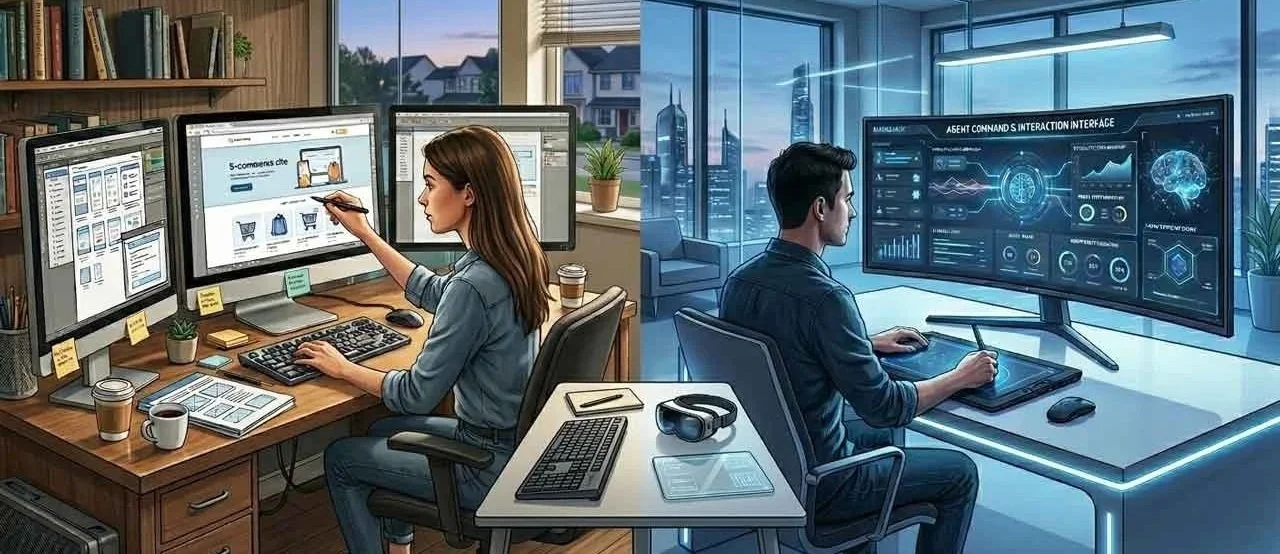
Moving forward
The AI Designer
Uses AI to handle the mechanical parts of the job, while designing products that work beautifully for humans and functionally for machines. They bridge the gap between human intent and machine execution.
Fading out
The Manual Designer
Focuses on aesthetics alone. Builds for human eyes, ignoring the machine layer. Their products become invisible to AI agents and to the modern commerce they drive.
The second designer isn't just faster, they're designing for a different reality. One where the audience isn't just the person opening the app, but also the AI acting on their behalf.
The interface is no longer just a screen
The future is an ecosystem of AIs working together to make human lives easier. MX Design is how we build the world where that happens well. The question isn't whether this shift is coming, it's whether your work will be ready when it arrives.